





Canford Automatic: deconstructed

Engineering obsession comes in many forms. For us, it’s about striving to make watches ever more functional, more durable and more user-friendly.
We definitely reside in the ‘difficult to do’ box when it comes to turning our ideas into engineering reality. It’s like an in-built magnet, pulling us involuntarily towards any enhancement we can make in the pursuit of the ultimate tool watch.
We’ve had 15 years since designing the original Canford and 13 years of living with those watches. That’s plenty of time to think, tinker and dream about what the perfect Canford could be.

Why 39mm
We don’t hold any particular preference for the precise millimetre diameter of a watch. We make watches in many sizes, and the most important thing is ensuring they wear beautifully across a wide range of wrist sizes.
We work tirelessly to increase or reduce the perceived volume of every one of our cases. Canford cases are – and always have been – minimalist, with essentially a top and side surface. It’s that side surface that could very easily make the watch appear too blocky or too tall. Look closely, though, and you’ll notice what we call an undercut: a chamfered area, often finished differently, deliberately designed to trick the eye. It’s all part of balancing the proportions of every watch case we design.
With an ambition to recreate Canford as a future classic – oozing understated class, but still a go-anywhere, do-anything watch with an automatic movement – it felt natural to reduce the size a little. But it still needed enough heft to feel right.
There’s no science to this. It’s a matter of personal taste, judgement and finding the perfect balance between visual impact and how the watch actually feels on the wrist.
At 39mm, Canford V2 feels spot-on.
It also happens to work across a greater range of wrist sizes, which was part of the brief from the beginning. Put one on and it seems to disappear on the wrist – and we mean that in a good way.
Size, balance, feel, weight, appearance, materials, finishes and premium, supple, colour-matched strap options all play their part.
Canford Automatic - design principles

Dials with beauty and function
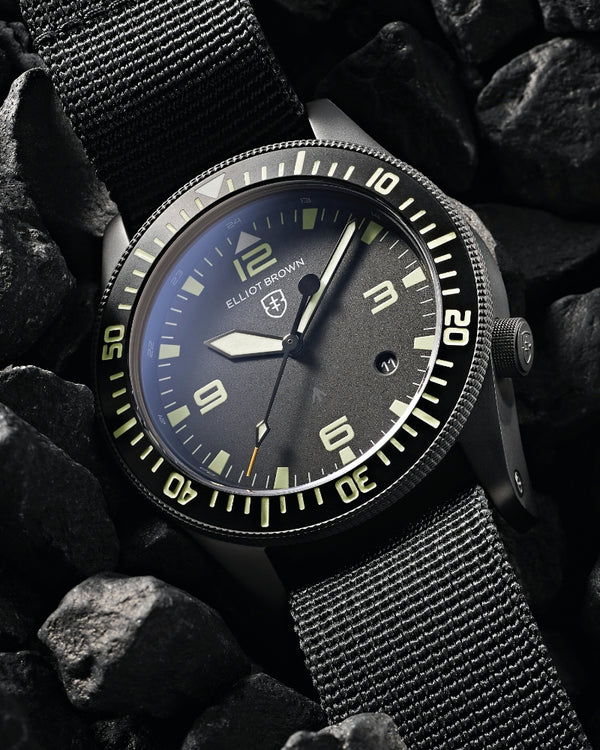
Canford dials have long been our blank canvas: somewhere we can express colour, play with light and experiment with finishes and subtle effects. Sometimes they quite literally pop in bright light; sometimes the texture sits at the very subtle end of the spectrum.
Our very first 202-001 Canford had a white dial with a texture reminiscent of a vinyl record. Why?
Imagine stretching out a corrugated sheet. Its actual surface area is much larger than its footprint suggests. With a grooved dial, we’re effectively compressing a much larger surface area into a smaller space, creating the beautiful effect of attracting and reflecting more light. The result is a colour profile with much greater impact to the naked eye.
The 303-A61-T01 is an homage to that original, with circular record grooves adorning the central dial area, framed by a gorgeous polished steel keyline. The outer dial is flooded with opaline white.
Having this blank canvas also meant we could experiment with new finishes and colours, and two in particular stood out from all the prototypes: fumé blue and fumé brown.
The blue gently fades to a paler shade at its centre. The brown has a subtle, fine-linen effect that suits its cool tone beautifully.
The combination of textured cool brown, polished steel accents and Super-LumiNova is a powerful one. It’s so good that we all found ourselves asking the same question: How have we never thought of this before?
They’re not just numbers
One of the key components in determining the overall balance of a watch design is its indexes – the numerals, batons or dots that define the dial.
The original Canford dials were printed, but knowing what we know today, we wanted to lift the automatic version visually into a different realm.
So we set about designing custom applied indexes, each fixed using tiny feet and corresponding holes in the dial. Every hour baton gently tapers towards the centre, so it doesn’t overwhelm the dial while still providing perfect clarity by day or night.
Their shape is known as a ‘dagger index’. We don’t use daggers, obviously, but it sounds cool.
The polished steel frame surrounding every dagger index and numeral marries with the frames of the hands and the finely polished highlights designed into the brushed steel watch cases. The overall effect is one of cohesion and precision that strikes just the right notes.
On the matt black 303-A64, it’s those polished steel highlights that catch the light in perfect contrast to the matt case.
For the A61 Opaline Dial, we went a stage further and blued the steel index frames, echoing the specialist blued steel traditionally found in fine gunsmithing.

Locking down the inner timing bezel
The Canford inner timing bezel has always been a detail with a particularly satisfying action. Rotate the upper crown and it moves with a perfectly damped, oily-smooth motion, with hardly any hint of cogs meshing beneath your fingertips.
The only downside? It can’t be locked in position.
That’s why we’ve always recommended it for casual timing – something in the oven, for example – rather than professional, time-critical duties. To our critical eyes, that was a weakness.
So, using the patented Beachmaster and its tactile, click-locking inner timing bezel as our starting point, we set to work on a mechanism that would be just as delightful and tactile to operate, but which could also be locked securely at the desired timing position.
The ultimate, in other words.
The Beachmaster’s 24-hour timing bezel took two years to perfect. We wanted it to feel almost like a fidget toy, with hardly any discernible play and exactly the right amount of resistance. It’s a technical masterpiece.
But, naturally, we wanted to go further.
We had a shared desire to enhance the function again – yes, with more complexity – and create the ultimate internal timing bezel: one that could be locked down securely and never knocked or moved once set. Perfect for professional use, yet smart, understated and incredibly easy to operate.
The result is a delightful piece of engineering.
The crown screws down into the case, not only locking the bezel safely against accidental movement but also securing the crown itself from knocks. Once screwed down, it effectively becomes bolted to the case – much tougher than relying on a relatively fragile, non-screw-down crown stem.
Win-win.

Why automatic?
Some years ago, we produced a watch called Tyneham. In many ways, it was the forerunner to Canford V2: classier, tough as nails and powered by a premium-grade Miyota 9130 automatic movement. We housed it in a slightly smaller case, inside our shock-protection system, with a glass display back and a neat power reserve on the dial.
Those movements rarely miss a beat. They’re beautifully made and hit all the markers for our most demanding audiences.
Reliability and reputation mean far more to us than any kind of movement snobbery. These are tool watches, after all, and the most important thing is that every watch we put our name to delivers huge bang for your hard-earned buck.
That’s why we had no hesitation in selecting the Miyota 9015 for the Canford Automatic.
It’s a well-regarded, premium-grade movement that operates at a high frequency for excellent accuracy, has 24 jewels and, importantly, its slim dimensions allowed us to house it inside our shock-protection system while maintaining the perfect external proportions.
Every movement is finished with a customised EB automatic winding rotor, etched with topographic contour lines inspired by our World Heritage Jurassic Coastline.
And, thanks to that subtly domed display back, you get to see it.
Features carried through to all our watches

Solid strap bars
The Holton doesn’t rely on flimsy spring bars. It uses solid steel bars, threaded directly into the case shoulders — the kind of fixed-bar security demanded by military operators. It’s an uncompromising connection designed to endure relentless vibration, impact and load. When this watch is on your wrist, it stays there.
Shock architecture
Inside, the movement is housed in a steel carriage suspended within elastomer shock absorbers, a proprietary system built to withstand the kind of violent G-forces that destroy ordinary watches. This is not decorative over-engineering. It is survival engineering.

2.8mm sapphire crystal
A 3mm sapphire crystal, significantly thicker than any industry norm, protects the dial and integrity of the watch. Each crystal must survive repeated steel-ball impact testing before approval. It is anti-reflective beneath the surface and recessed to guard against edge damage.
Individually water tested
Every watch is pressure-tested in water to its full 200m (20ATM) rating before leaving the workshop. No batch assumptions. No theoretical claims. If it reads 200m on the dial, it has already proven it.
You can wear the Holton safe in the knowledge that it is meticulously engineered from the ground up with more natural durability than most users will ever need, but it's good to know it's there.