




1,921 Metres: The deepest Elliot Brown Holton ever

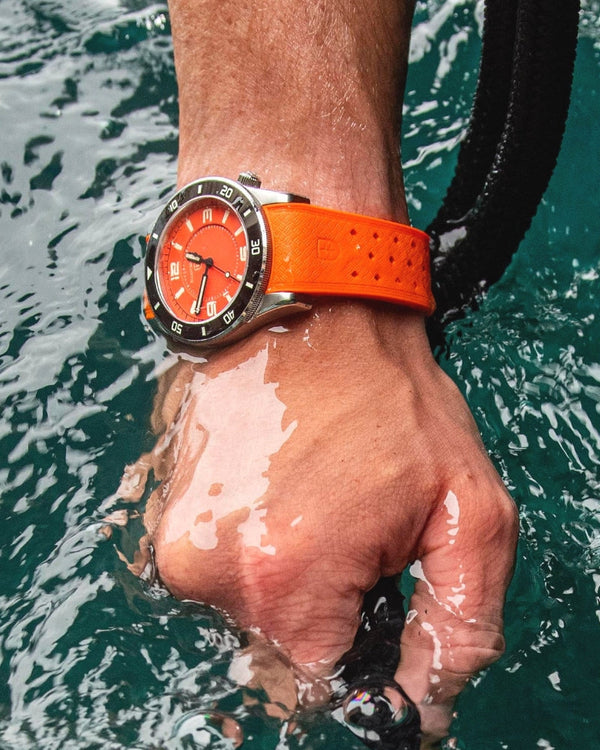
As underwater watch adventures go this one is special
In Feb 2020 Elliot Brown was approached by, Adam, a watch enthusiast with an ambition to do some ‘real world pressure testing’ under water. Adam then explained that he’s a submersible ROV pilot (Remotely Operated Vehicle) and wanted to see just how far one of our standard watches could survive below sea level. Ian and Alex’s response? “Hell yes!”
“I came across Elliot Brown when chatting with my old colleagues from my military days, then totally geeked out when I learned what EB stands for and how they go about creating a watch that isn’t only fit for purpose but handsome too. I wanted to see if I could strap a couple of watches to the sub, send it subsea, to the sea floor in the Gulf of Mexico, and see how well they would hold up”- Adam
We are no strangers to extreme testing, having blown watches up, sent them round the world on the bows of race yachts, fire bombed them, run over them and field tested them for years on elite military operators. You may not be aware but every watch we make must pass a 200m or 300m wet pressure test in water, which says everything you need to know about how seriously we take the term ‘fit for purpose’. This opportunity was too good to miss and would provide the answer to a question we have often wondered - how deep could a standard Elliot Brown Holton watch descend before it fails? What will fail first?
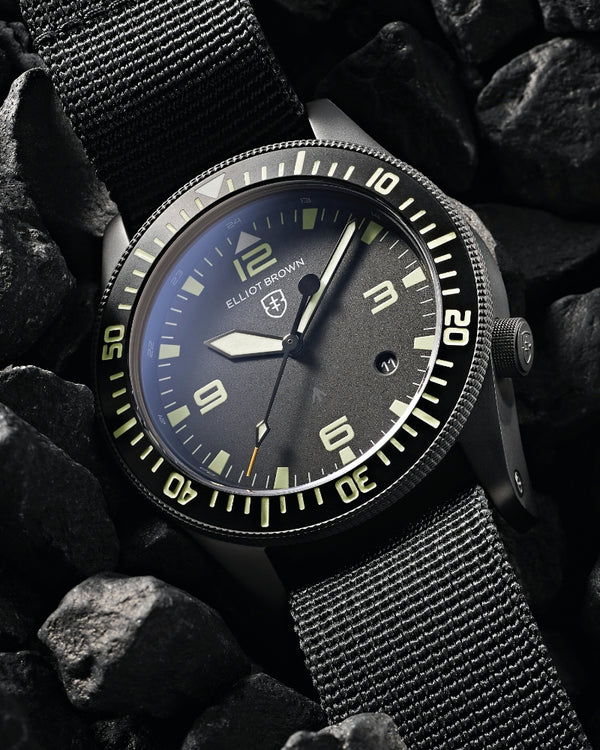
The natural watch for the task was the Holton Professional, designed for an arduous life on and under water in conjunction with a specialist branch of the British military. As a bit of a curve ball, we also sent the Kimmeridge, seen by many as the ladies watch within Elliot Brown’s collections.
“We over-engineer our watches so we know they’ll perform in conditions harsher than any human can endure - but we’ve always wanted to discover just how far they’d survive under water. 300m?, 500m?, 1000m? Time to find out” - Alex Brown
Adam collected a couple of standard watches taken randomly from stock.
With a short hop over to the Gulf of Mexico, a quick confab to decide the best position and secure way to mount the watches, the ROV was ready to descend into the deep. Mission depth 2080m (6,693ft). Every 10m(33 ft) of depth adds 1 bar/14.7 psi of pressure.


Dive details from Adam
Mission: Test Elliot Brown Holton Professional and Kimmeridge watches subsea to determine capability to withstand pressure.
Method: Mount the watches securely on the ROV in a position where they can be observed at all times. Gradually descend through the water column down to 2080m (Sea bed) and monitor, taking notes on any change in performance.
Date of dive: 08.03.2020
Location of dive: Gulf of Mexico
Time of dive: 1745hrs

Rate of Descent:
| TIME | DEPTH | NOTES |
| 1745hrs | 0m | |
| 1750hrs | 155m | |
| 1800hrs | 381m | |
| 1812hrs | 625m | |
| 1824hrs | 958m | |
| 1826hrs | 1000m | |
| 1837hrs | 1403m | Kimmeridge working up to this depth |
| 1901hrs | 1921m | Holton working up to this depth |
| 1917hrs | 1921m | Holton catastrophic failure – glass gave way under the pressure |
Kimmeridge Point of Failure
Time: 1837hrs
Depth: 1403m
The Kimmeridge performed really well! It was working well right up to 1403m. At that depth, the second hand simply stopped – all hands stopped.
“Let’s just pause there for a moment. A humble Kimmeridge (same case as Arne) equipped with a push in crown reached a depth 1403m.. that’s insane!” - Ian Elliot
Later in the dive at 2080m although still intact, gradual water ingress was observed into the face between the dial and the face. The crown seal had been compromised.

Holton Professional Point of Failure
Time: 1901hrs
Depth: 1921m
The Holton was unbelievable – it continued to work correctly up to a depth of 1921m where the hands simply stopped moving. A few minutes later at approx 1906hrs we stopped at 2000m, no water ingress was noted.
At 1917hrs at 2000m the watch face suffered a catastrophic failure – the watch face imploded.
After reaching 2000m the dive continued further to a final depth of 2080m.

Both watches were constantly observed and the respective points of failure witnessed and noted, with specific depths and times recorded.
“The team can’t quite get their heads around this data, it’s extraordinary and neither could the crew watching the footage coming back, the test caused quite an audience. Sadly, there is no footage of the final stages of the experiment as the project leader pointed out that there was a (real) task to be completed in addition to the watch test. No one expected the watches to reach such depth in-tact. Minds and expectations have been well and truly blown. 12 new EB customers aboard the vessel!” - Adam
1921 metres: The deepest Elliot Brown Holton ever
One thousand, nine hundred and twenty one metres. It’s got a ring to it. And at just under 2 kilometres under water, that's a pressure of 2800psi, 6,302ft, 192bar.
“We’ll keep over-engineering our watches and geeking out over tiny improvements that no-one will ever notice. It’s why we do what we do and when we send our watches into the wild on human wrists as opposed to highly specialised research equipment, we sleep well knowing they’re more than up to the job.” - Ian Elliot