





The Beachmaster Symbology: Rooted in History

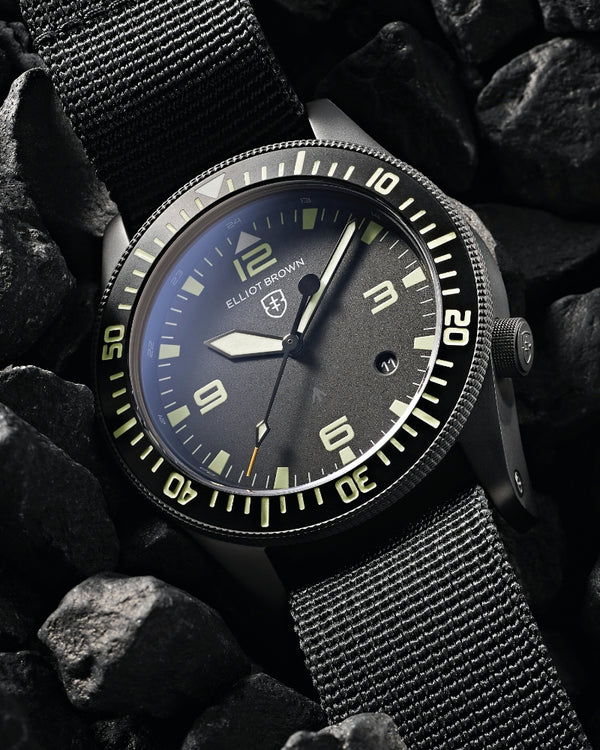
The Beachmaster was conceived around the D-Day landings, and as such we took a deep dive into the NATO Battlespace Iconography Guide (as you do) for relevant and inspiring details we could bring to life as part of its authenticity, and to complement the functions of this remarkable watch.
The first symbol we selected is a simple wavy line, which also happens to be the NATO symbol for an amphibious assault. You'll find it on the case back, in the booklet, and repeated as a wallpaper across sections of the dials, giving them a unique but entirely relevant character.
The octagonal shape on the case back deserves a little more explanation. Its shape acts as a size guide for NATO signage, where the horizontal and vertical dimensions of a rectangular sign must conform to a specific ratio and fit within the octagon.
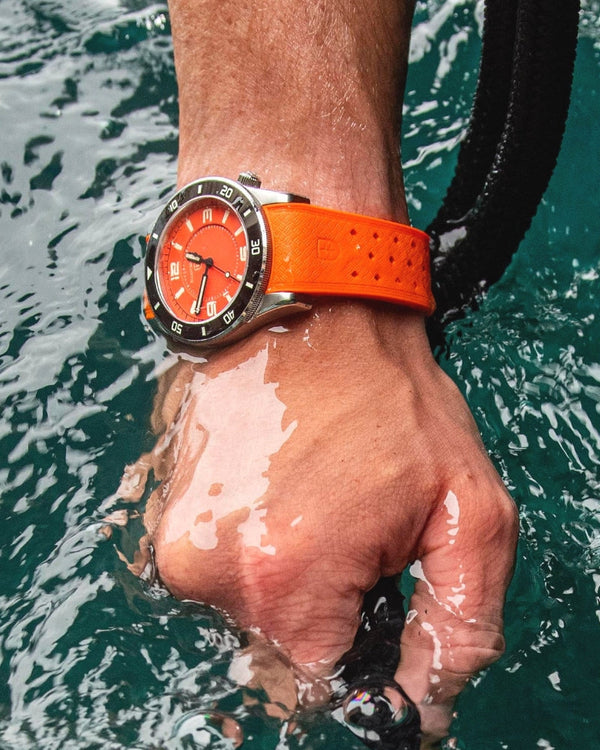
The letter H on the 24-hour mission timing bezel denotes the specific, often classified, time at which a military operation, attack or amphibious landing begins. Once set, it acts as an anchor point for all subsequent movements: H-10 hours, H+1 hour, and so on. On D-Day, 6th June 1944, H-Hour was set for 06:30 local time to align with low tide. The timing bezel on the Beachmaster counts down from H-12 hrs to H-Hour, then counts up to H+12 hours, the world's first 24-hour analogue mission timer.
For the rest of us, H could simply mark high tide when you're boating or paddleboarding up an estuary. Very handy indeed.

Probably the most recognisable symbol we use is the three-pointed arrow shape, also known as the Crow's Foot or Broad Arrow, primarily used by the Board of Ordnance to mark British government property.

We use it on the Holton Professional in conjunction with a NATO Stock Number (an item recognition number used in NATO procurement), because the watch is issued to UK special forces and the exact same model is available to the general public.