





The Longest Row

When Dinger told us about his row, we were sitting with him, having a coffee in our local town with our partners. He was calm, talking about it as if it were entirely normal, yet he was about to attempt what no human had ever come close to achieving. It was impossible to comprehend, but in his head he had broken it down into what he felt were achievable sections. He would attempt the Pacific, the Barrier Reef and the Torres Strait to reach the top of Australia. Then, after a check of himself and the boat, if all was well, he would continue across the Indian Ocean all the way to Africa. Two-thirds of the way around the world! If you look at it on a world atlas, the extraordinary scale is immediately evident.
Lima, Peru, in South America was his jumping-off point. He suffered huge import tariffs on his food stores, despite the fact he wouldn’t be using them in the country, and that was just the tip of a very big logistical challenge before he could even begin. He departed on 9th November 2025 (Remembrance Sunday) in a custom-built ocean rowing boat. He left behind Georgie, who would later embark on her own adventures to help with the mental challenge of waving goodbye to a partner who is attempting something so huge it’s hard to grasp.

The Pacific is dominated by two weather systems, and both were largely favourable for Dinger. The crossing had been carefully planned for timing, pace and distance, with currents and winds helping rather than hindering. His progress was so fast, however, that he had to stop rowing for nearly three weeks, remaining on a para anchor (like a sea parachute) to avoid running into major weather systems.
Having to stop rowing when that’s what you’re there to do is not easy. Mentally it was the most challenging time, but he made the most of it, keeping everything maintained and shipshape. Boats that cross the Atlantic cover in the region of 3,000nm and need a full rebuild afterwards. His boat needed to complete five times that distance, so keeping it strong and in good shape was paramount.

He had good comms and was able to send voice and video notes in reply to any messages, which meant he never felt alone. He became adept at talking into his phone, getting everything off his chest while remaining relentlessly cheerful.
On his approach to Australia, his food rations were where he needed them to be, he was in great spirits, and everything was working well.
Suddenly, the relative safety of deep water was gone. In its place were atolls and reefs, where the depth could change from 200m to 10m in an instant, creating huge surf and currents impossible to row against if he got it wrong.
With waymarks and advice from Simon (his weather router), he made it through, then on to the Torres Strait, the most treacherous stretch of water, and one no human had successfully rowed, let alone with a Pacific crossing sitting heavily in his tired arms and body. In distance terms this was over halfway, but he had to put in 18-hour shifts to navigate the atolls, heavy tidal flows and surf. This section of his journey had always been viewed as the most dangerous and a bit of a lottery. He was fortunate.
The other side of the Strait was his mental halfway mark, where he could at last take stock, assess his own state along with that of his boat, and decide whether to continue along the northern coast of Australia and on across the Indian Ocean to reach Mauritius or the Seychelles.
For weeks he was followed by sharks and sea birds, which used his overnight recuperation to turn his boat into a regurgitated fishy smorgasbord. He had to fix everything that broke or failed, and at one point he was just 20 miles from Billy Taylor and his Indian Ocean rowing team, who sadly had to call time on their crossing due to rudder failure. Their rescue by an oil tanker had a profound effect on Dinger, having shared comms with them for days beforehand. It left him feeling extremely vulnerable.
The Indian Ocean’s swells and weather are wilder and less predictable than the Pacific’s, with swells typically 2–4m and regular storm systems. The unpredictable conditions caused two oar breakages, meaning he was down to his final pair of oars for the last 1,000 miles or so.
As he reached the northern tip of Madagascar, the swells whipped up to 4.5m and the winds into the 30s and 40s. These were not the conditions you want when you have no more spare oars, and he was forced to put the para anchor out several days a week as system after system hit.
His published route had always been to reach an African island nation (Mauritius) rather than the African mainland. But when he announced that currents and winds had taken him further north than planned, the elation in his voice notes was palpable, because the new final destination was mainland Africa, which had always been in his heart. It meant adding another 1,000nm to his gargantuan journey, but it would give his mission the perfect ending, if he could make it.
And make it he did, landing on the beach at Kilifi to exactly the reception he had hoped for: not too overwhelming, just enough, 327 days after leaving Peru.
To complete an ocean crossing, the rower must beach the boat, jump off and take hold of sand from the shore. In Dinger’s case it was handfuls of weed, but he’d done it, and the hug from Georgie will never be forgotten.
Standing was difficult, walking harder still. He was hearing voices and seeing people, but little was registering after so long in solitude. Over the next few days and weeks, orientation slowly returned. The African hospitality was overwhelming, and he said that his first time in a car, at 25km/h, felt like a space shuttle, given he had spent nearly a year at nothing more than walking pace.
His row has redrawn the limits of what is achievable. Just trying to comprehend it is nigh on impossible, and the acclaim he continues to receive is testament to his raw courage and bravery. Looking back, that conversation over a coffee in town feels like yesterday, yet in that blink of an eye Dinger has completed the longest single-handed, unsupported row in the history of humankind. He and his team are legendary.
During his time on the water, he was raising funds for Rock2Recovery, a mental health charity that assists thousands in the military and blue-light communities. They provide an instant response to so many who often fall through the gaps in their employers’ welfare systems, and to veterans with nowhere else to turn. It’s a charity close to our hearts, and when Prince William made a donation, the King also became aware of Dinger’s extraordinary achievement. It clearly had a profound effect, because the King, as Captain General of the Royal Marines, sent a beautiful personal note to Dinger (a veteran), complete with a very special bottle of whisky. If you have been holding a donation back, wondering whether he would reach Africa, now’s the time. Please show your support and appreciation if you can.
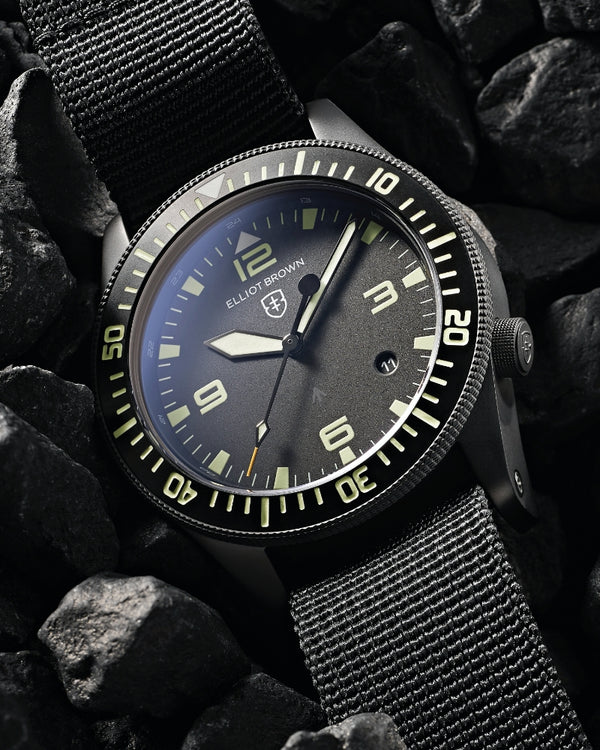
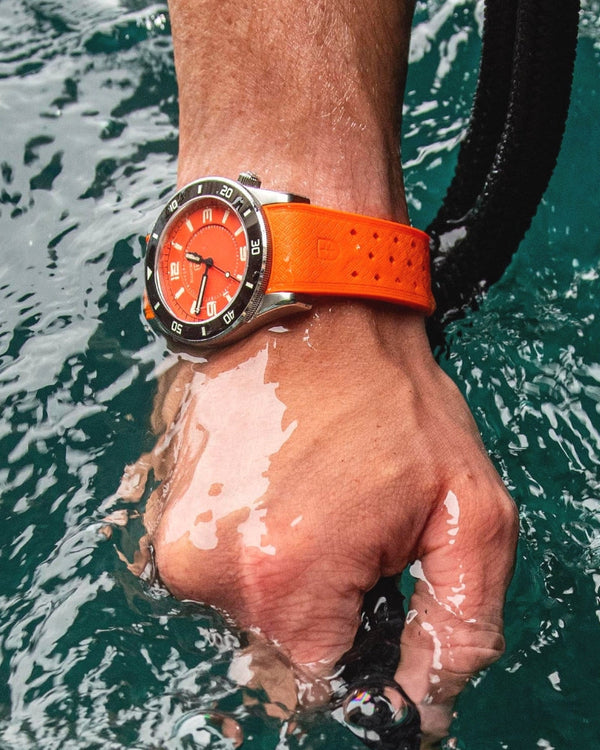
Our connection with Dinger goes beyond watches and rowing, but just for the record, two very special watches that accompanied him all the way will appear at auction. He’ll also be handing back our ‘Row It Forward’ watch, having put another two oceans under its belt. That makes the total ocean crossing count for this extraordinary watch eleven (Oceans 11!), with a total distance of 37,000nm covered.

Dinger describes himself and this mission as a team effort, with him just being the guy on the oars. His ground team was primarily his partner Georgie, for logistics and safety, plus Simon, who provided weather routing, helping him avoid the worst of the storms and waymark his route through treacherous sections. Dunc Roy provided essential advice, along with talismanic notes and treats that could only be opened and enjoyed when specific milestones were achieved, each a huge emotional boost. Dinger describes the bromance he developed with Jamie from Rock2Recovery, as the two constantly checked in on each other.
Dinger is an ex-Royal Marine. You couldn’t meet a more unassuming human, and he doubted himself and his abilities throughout. He is clearly blessed with extraordinary courage and competence, and able to excel in complete solitude with only himself and his abilities to rely on. He is also blessed with extraordinary knowledge of everything the mission required, from maintaining electronic systems to engineering and understanding oceanic and world weather systems. He has mastered the maintenance of his body and mind, and to say this mission was the single most positive experience of his life is beyond extraordinary. Yet there we were, chatting all along the way, and he genuinely was in his happy place.
Dinger, we love you, mate. You’re an extraordinary human.