




Protection built in
There's a saying in watchmaking that the most important work is the work you never see. At Elliot Brown, we'd go one step further: it's often the work nobody else bothers to do in the first place. From the way a movement is protected inside its case, to the number of seals around a crown, to the precise thickness of a crystal, every decision we make is deliberate, tested and built to last.
In this journal we're pulling back the curtain on some of the engineering details that define every Elliot Brown watch. They're not the features that shout loudest on a spec sheet, but they're the ones that make the difference when your watch is put to the test, which, knowing our customers, it will be.
Movement Protection

Many people judge a watch's toughness by the material used for its outer case, but there's a big "but" here, and it's an important one. Very few watches also feature a movement shock protection system to complete the picture. Without it, the outer case may be able to take a knock, but that shock can still be transmitted directly to the movement inside, potentially damaging it. It's something we witnessed first-hand during our time at a company called Animal.
When Elliot Brown was being conceived, we were in a unique position to understand, and resolve, how movements can be damaged by transmitted shock. We effectively deconstructed what the industry uses to secure a movement inside an outer watch case, and methodically set about creating an inertia-based floating protection system. It's inside every watch that carries our names and is a fundamental part of our DNA. It's a detail that can easily be glossed over when choosing a watch, but it has a literally huge impact (sorry!) on what your watch is truly capable of.
Having worked it all out, it would have been ideal if one design could serve all of our watch models, but every movement type has a different diameter, depth and weight. We then complicate things further by adding triple seals for the crown stems and, in some cases, internal click-lock rotating bezels, both of which require their own unique internal architecture and engineered solutions. Some of our movement shock systems are solid stainless steel discs with a recess bored out to house the movement. Where a movement has more depth but the overall watch dimensions need to stay compact, we adapt the shock system accordingly, in those cases it may take the form of an outer ring with a recessed lip rather than a full metal disc. Each system is carefully configured with dampers built into recesses on the movement holder itself, or machined into the inner walls of the outer case. In every instance, it's this kind of intricate engineering that we obsess over, and once you know it's there, it gives every one of our timepieces a sense of quiet invincibility.
Solid Strap Bars

In our world, sprung strap bars are perfectly acceptable — but only in the right circumstances. For ultimate strength, we created what we believe is the ultimate yet convenient solution. Let us explain.
A spring bar consists of a thin metal tube with cinched ends, inside which sits a spring and small pushers with ridges that allow them to be depressed and removed with a strap bar tool. In applications where strap attachment strength isn't a primary concern, the system works really well, and there are many refined versions available, including designs with an added nodule that lets the user depress one end without any tools.
We're happy to use spring bars only when the bar itself has firm support from the surrounding material, preventing it from bending under load. In such cases, the inherent weakness of the tube can be largely overlooked, because the force required for failure transfers to the shear strength of the solid metal ends. Our co-founder Ian Elliot famously demonstrated this by hanging from a boat crane at our waterside HQ using nothing more than one of our metal bracelets, spring bars, solid bars and all.
Since founding the business in 2013, we have always used solid strap bars for the strap-to-case attachment, purely for their superior strength. We then developed these further into the simple screw-in type we use today when creating the Holton, which needed to be genuinely "squaddy-proof." The screw-in solid bar system threads into the watch case on one side, takes about a minute to swap straps, and is strong enough to keep a watch secured to the bow of a round-the-world racing yacht through 50,000 nautical miles and a year at sea, hitting everything in its path. We've yet to find, or develop, a better system for ultimate strength, longevity and easy strap changes. People really love them.
How Many Seals Does a Crown Need?

The crown, or crowns, on a watch are the grippy rotating cylinders on the side of the case, connected via a metal shaft to the movement or another internal component such as an inner bezel. They allow the wearer to adjust the time, date, set a GMT hand, or operate an internal timing bezel such as those found on our Beachmaster and Canford watches.
The challenge with any component that has a direct link to the inside of a watch is that it creates a potential weak point. That point needs to be properly sealed against dust and moisture, to the same standard as the seal around the crystal, any chronograph pushers, and the case back.
There are numerous sealing methods available. In the majority of watches, a tiny O-ring is used where the metal shaft and crown are pushed or screwed into the case, "activating" the seal. In the case of a fixed crown that rotates an inner bezel, the seal is permanent and allows the crown stem to turn freely within it.
When designing our first Elliot Brown model, the Canford, we wanted to eliminate the user errors we had frequently encountered at our previous company, where watches were fitted with screw-down crowns. These require the user to push and turn the crown firmly against the case to create a seal, and we had many uncomfortable conversations along the lines of: "My watch has leaked, I need you to look at it or replace it under warranty." We'd receive the watch back, pressure test it with the crown properly screwed down, and find it perfectly watertight. The crown had simply been left unscrewed and unsealed before being submerged. The conversation that followed was never a pleasant one.
That experience is precisely why the Canford crown was re-engineered with three separate seals that work continuously, whether the crown is pushed in or pulled out to any of its adjustment positions. Not the simplest solution to engineer, but we genuinely cannot recall a Canford being returned due to water ingress past the crown seals. Every single one also passes our 200m wet pressure test.
When we designed the Holton, the crown needed added protection from knocks and equipment. It needed to become part of the case, recessed and out of harm's way. Rather than adding crown guards to the sides of the case, we created a solution that doesn't need them. Positioning the crown at 4 o'clock is a good start, as it avoids the point of maximum case width at 3 o'clock. We then recessed it deeply into the case to move it further from harm, but this created a new challenge: maintaining three seals with significantly less metal thickness to work with. The solution is two permanent seals, with the third seal engaging when the crown is screwed down. It's not fully sealed when unscrewed, but when locked down it effectively becomes an indestructible bolt, with three seals more than capable of keeping a standard Holton watertight to a depth of 1,921 metres, as demonstrated when one was mounted to an underwater remotely operated vehicle in the Gulf of Mexico. Nearly 2km deep.
Watch Crystal

When we started the business, we were convinced that mineral crystal was our friend in terms of ruggedness. Here's our thinking. After a series of tests and thorough research, we found that mineral glass is slightly softer than sapphire and therefore marginally better at resisting shattering. It became our material of choice, and all of our earlier models featured a mineral crystal with a multi-layer anti-reflective coating applied to the inside surface for excellent clarity.
We'll be completely honest: in those early days, when our volumes were low, cost was also a factor in that decision, but it was still the right call for functionality.
We had zero problems with mineral glass, and in our hearts we'd still favour it in some respects, because under a really hard impact it helps maintain the integrity of the timepiece a little better. However, there's a widespread perception among watch buyers that sapphire is superior in every way and for every purpose. It's something of an industry misconception, sapphire is better at resisting scratches, and that's what our customers wanted most. So as our volumes and buying power grew, we were able to absorb the additional cost and made the switch.
In practice, before and after the switch, it is incredibly rare for us to see a glass breakage on any of our watches. We specify crystals as thick as we reasonably can without the dial appearing as though it's being viewed through the bottom of a bottle, and that decision pays dividends in terms of longevity. We regularly hear from customers who've accidentally struck their watch against a wall or door frame — and it's generally not the watch that comes off worse.
One thing worth knowing: the seal around the crystal is called an i-ring. It has a tapered inner surface that the glass compresses as it's pressed into the case. Most manufacturers use white or black i-rings, but we colour ours to match the dial, so there's no risk of the seal compromising our carefully considered dial and bezel designs.
Flat, Domed or Box Crystal?
The type of crystal completely changes the character of a watch. We use several types, chosen for both function and aesthetics.
Flat crystal can be made exceptionally thick, we go up to just under 3mm. When people see it in the flesh, their first reaction is usually surprise that a crystal can be that thick and the watch still look so good. We worked all of that out from the very beginning, and the result is something so tough that even hammer blows struggle to cause any damage.
Domed and box crystals give watches a lovely, more classic feel, and we use them extensively. Box crystals are a variation on the dome — they share the same curved surface but also feature a "boxy" outer edge that rises proud of the case. These types are harder to produce at the same thickness as flat crystals, because visual distortion becomes a factor. You'll notice a gradual variation in thickness across a domed or box crystal, carefully calibrated to maintain clear dial visibility. These crystals naturally sit higher and are more exposed than flat types, but when made thick and tough, they are more than durable enough.
What is that blue reflection you sometimes see on the edges of our crystals?
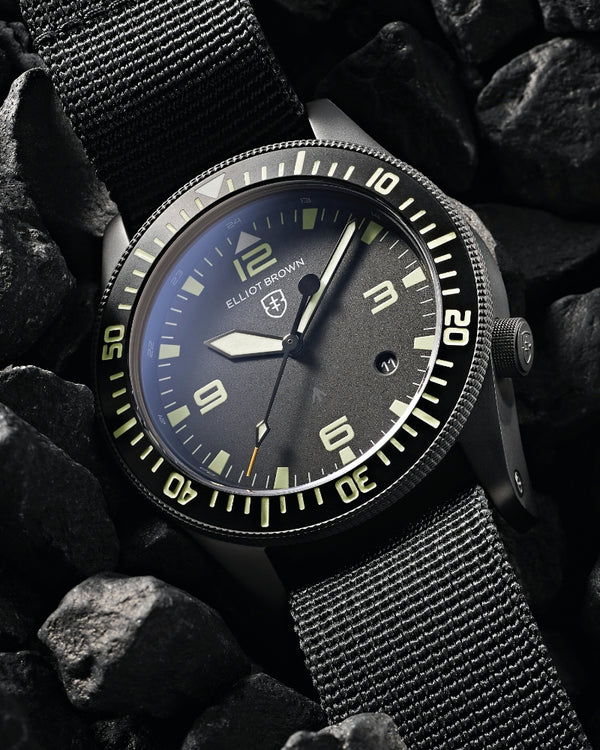
That's the anti-reflective (AR) coating, which can be produced in virtually any colour. We specify blue for most models because, to our eyes, it strikes the ideal balance between clarity and visual appeal. For some models we opt for a clear AR coating where pure functionality is the priority and there's no visible edge on the crystal.
Some manufacturers apply the AR coating to the outer surface of the crystal as well. We trialled this extensively and concluded we simply couldn't accept the smearing and fingerprinting it caused — an inconvenience nobody needs. For that reason, we apply it to the inside surface only.