A patent is an exclusive legal right granted by the government to protect an invention, specifically how something works.
If you create a unique device, method, or process that solves a technical problem, and it introduces new and inventive features, it may qualify for patent protection. This gives you the right to prevent others from copying or using your invention without permission.
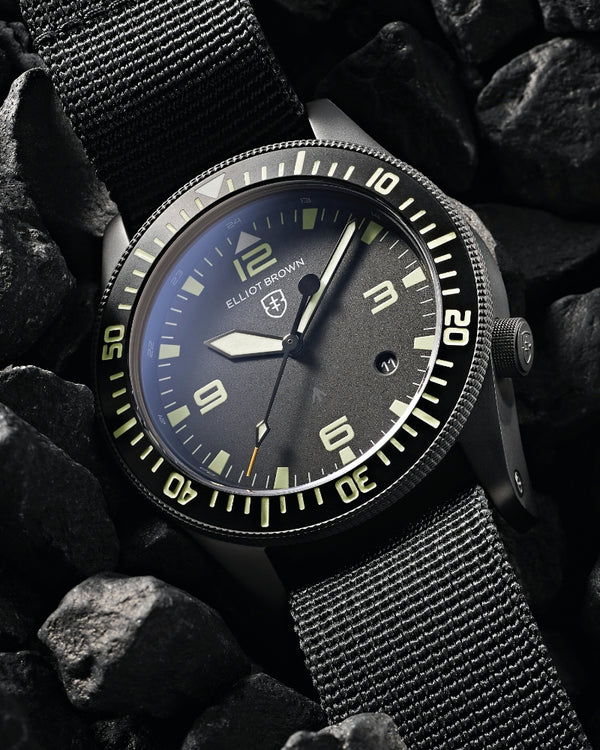
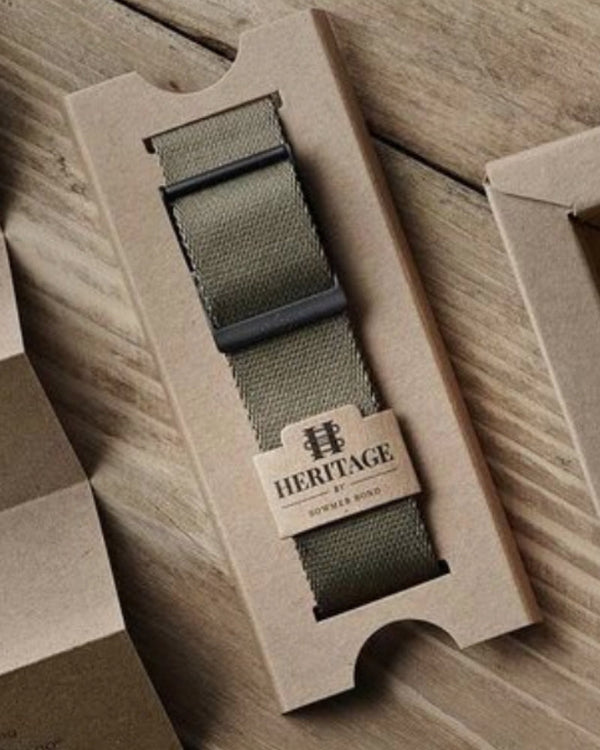
We’ve always pushed the boundaries of what’s possible, working tirelessly to secure not one, but two patents. One for our Beachmaster timing complication and the other for our strap clamp buckle used on our webbing.
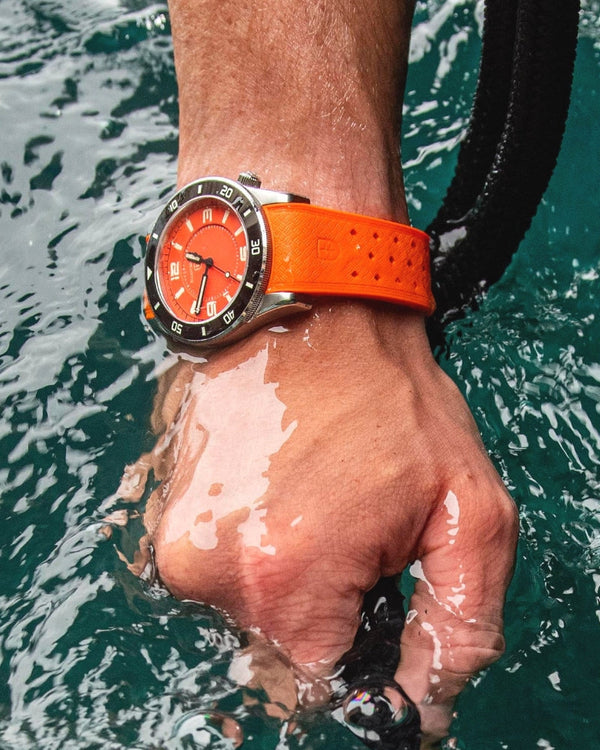
These innovations are just a few examples of the ingenuity behind every Elliot Brown watch, designed to give you complete peace of mind. They’re also why we can confidently stand behind our 5-year warranty, without hesitation.
You have to diligently prepare and send tens or even hundreds of annotated drawings and explanations, to a Patent Examiner explaining how the invention works.
If the examiner feels it is a new invention it is published in a journal for all Patent Attorneys to view and possibly to object to. If no-one objects, the Patent Examiner may grant a new patent.
The process can take a couple of years and the invention cannot have been sold commercially before the application is placed.
Ok now that that’s out of the way...
How did we come to own a couple of patents?
Our first business began with the invention of an unbreakable watchstrap made by passing a strip of hook and loop material through the pins of a watch then onto a loop of webbing that could be wrapped around a wrist or any object. They were infinitely adjustable and virtually indestructible. It solved a very real problem: losing a watch while surfing.
That was our first invention. But in our naivety, we sold them before the thought of protecting them with a patent even crossed our minds. Valuable life lesson number one!
It didn’t matter. We sold millions. Those straps went on to fund what became an international board-sports business, which led us into watchmaking.
We made the straps in all manner of materials and guises, they became a national trend and for some, a way of pushing back against the rule-makers, thanks to their fluorescent colours and often unconventional appearance.
At one point, a Falklands War Harrier pilot featured on the BBC’s Six O’Clock News even had them (officially) banned on military operations due to their non-conformist colours. Ironically, in that pre-internet era, the exposure gave them an enormous boost.
We learned a lot about the use of fabrics for watch straps, like how they could become incredibly filthy or smelly in the wrong hands. That hook-and-loop fasteners had a finite lifespan, made noise when opened, and never quite delivered the level of sophistication we were striving for.
Fast forward and we were looking at ways of creating a webbing strap that retained the same core functionality, but elevated it in every way. More refined, more durable, silent in operation, odour-resistant, and finely adjustable.
Our outdoor and sports pursuits meant we were constantly using webbing straps on backpacks and gear, paired with all manner of buckles and clamp systems. We wore belts with toothed cam-lock buckles and gathered examples of everything we could lay our hands on, studying them for inspiration.
We discovered that a ladder-lock adjustment system would allow us to pre-set the strap length, ensuring the tip always sat exactly where it should. But we couldn’t find anything that secured the webbing firmly at that precise length. So we set out to create it ourselves.
We began sketching by hand, working through how a buckle could clamp the webbing securely while remaining flexible enough to flex around the wrist. It needed to hold a watch safely, be quick and intuitive to use, and just as easy to remove.
It took three years.
We had developed a beautifully resolved solution: a hinged clamp buckle paired with our own refined webbing.
When the first tooling and samples arrived, it was clear we were onto something, but it still wasn’t perfect. More fine tuning followed, and during that process, we took the opportunity to explore whether the idea was truly unique working with a patent attorney to assess its originality.
We were lucky. Within a year, the patent examiner confirmed what we had hoped... we had created an entirely new type of webbing clamp buckle!
Our first patent was granted.
The second patent took almost as long. The idea grew from a challenge to create a watch with a 24-hour mission timer, conceived around the D-Day landings.
The world of Horology is a creative one, it sucks you in. Over decades, it has produced remarkable inventions, some deeply functional, others driven purely by curiosity. It’s also a crowded space, with almost every brand striving to claim originality, particularly in the tool and go-anywhere-do-anything watch category, where purpose and performance are everything.
The enforced periods of contemplation imposed on us during the pandemic gave us the rare breathing space to finally work out how we could utilise a normal GMT movement to create a brand new complication.
Despite the millions of GMT and tool watches already in existence, we developed something genuinely new: a highly practical system centred around a dual-arrow GMT hand. This allows the wearer to reference both a 24-hour scale and a combined countdown/count-up scale, controlled via an internal click-locking bezel designed to prevent accidental adjustment.
While it may sound complex, it’s remarkably intuitive. By rotating the inner bezel in relation to the GMT hand, you can set a countdown to a defined start point. Once that moment arrives, the watch seamlessly transitions into timing the mission itself, for up to 12 hours, making it ideal for coordinating RV points or timed check-ins.
From humble beginnings, the result is something entirely unique: highly functional, visually striking, simple to operate, and protected by patent.
It’s worth noting the other forms of protecting ideas and creations as there are many misconceptions out there so bear with us just for a moment...
A patent is not to be confused with a trademark, which is more generally associated with a name or words such as a brand name which may sit alongside or be part of a logo that together or separately are called a marque. The way something sounds can also be a trademark or more importantly if a different word or sounds is deemed to be too similar to a trademark, it could be an infringement known as passing off.
You generally need to be able to demonstrate use of a trademark to achieve and renew a registration whereas you can only apply to Patent an idea that has never been commercially sold.
Registered Design protects a specific image or graphic work from direct copies but isn’t considered to offer great protection.
Copyright is often associated with written, spoken or musical words but also applies to pretty much anything that has been designed and created. Copyright ownership naturally rests with the creator/author unless it is assigned by them to someone else.